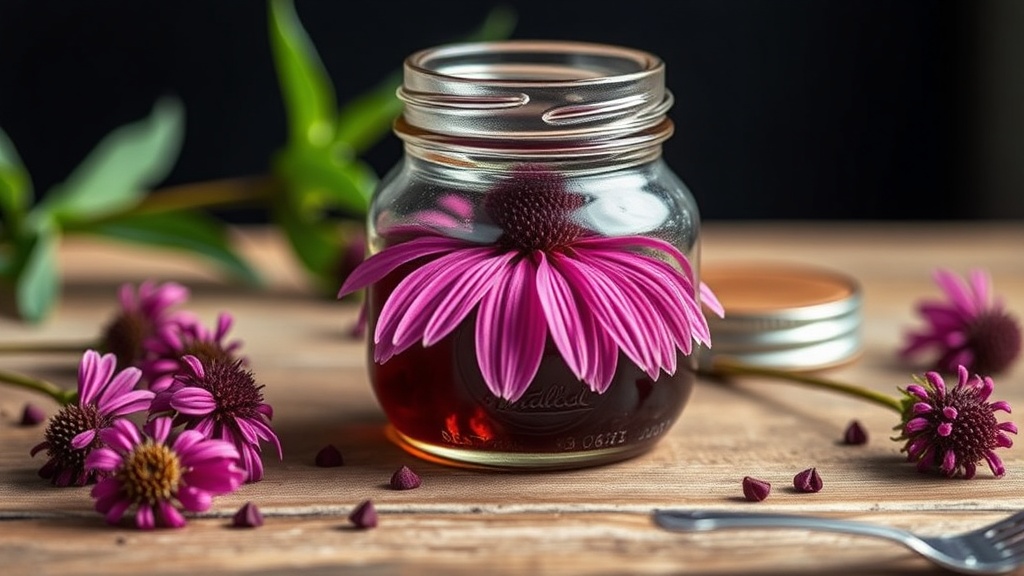
How to Make an Echinacea Tincture That Actually Works

Why Most Echinacea Products Fall Short (And What You're Missing)
You've seen the claims—echinacea prevents colds, shortens illness, boosts immunity. But walk into any health food store and you'll find shelves of echinacea products that range from potentially helpful to outright useless. The problem isn't the herb itself. It's that most commercial preparations use the wrong plant part, harvested at the wrong time, extracted poorly, or dosed so low you'd need to drink a bottle a day to see any effect.
This guide covers how to make a clinically relevant echinacea tincture at home—one that captures the alkylamides, polysaccharides, and caffeic acid derivatives that actually interact with your immune system. You'll learn which species to use (yes, it matters enormously), when to harvest for maximum potency, and how to extract the compounds that standard capsules often miss entirely. Making your own isn't just cost-effective—it's the only way to guarantee you're getting a preparation that matches what researchers actually studied.
Which Echinacea Species Should You Actually Use?
Here's where the confusion starts. Three species dominate the market: Echinacea purpurea, Echinacea angustifolia, and Echinacea pallida. Most clinical trials showing immune-modulating effects used E. purpurea aerial parts or E. angustifolia root—not randomly combined extracts, not E. pallida (which research suggests may be less active for immune support).
E. purpurea is the most forgiving for home medicine makers. It's easier to grow, more widespread, and the aerial parts (flowers, leaves, stems) contain significant alkylamides—the compounds responsible for that distinctive tongue-tingling sensation that signals active constituents. E. angustifolia root is traditionally prized but requires 3-4 years of growth before harvest and is harder to cultivate. For your first tincture, stick with E. purpurea—either homegrown or sourced from a reputable herb supplier who can verify harvest timing and drying methods.
The tingling test matters. Alkylamides are your quality marker. If a tincture doesn't produce slight numbness or tingling on your tongue, it's lacking the very compounds you're after. This is why many commercial products fail—they're either too dilute, made from old material, or processed in ways that degrade these volatile constituents.
When Should You Harvest Echinacea for Maximum Potency?
Timing isn't everything—it's the difference between a tincture that modulates immune function and expensive brown water. For E. purpurea aerial parts, harvest when flowers are fully open but before seed set. This typically falls in mid-to-late summer, depending on your growing zone. The alkylamide content peaks during flowering and drops significantly once plants shift energy to seed production.
If you're working with root (whether E. purpurea or E. angustifolia), wait until fall—after the plant has flowered and energy has returned to the root system. Dig on a dry day, wash thoroughly, and chop while fresh. Dried echinacea root works for tinctures, but fresh root captures a broader spectrum of volatile compounds that alcohol extraction preserves beautifully.
Never harvest wild echinacea populations. Many native stands have been decimated by overharvesting. Grow your own or purchase from cultivated sources. The United Plant Savers organization tracks at-risk medicinal plants and provides guidelines for ethical wildcrafting—when in doubt, assume echinacea needs protection unless you can verify sustainable sourcing.
What's the Best Method for Extracting Echinacea's Active Compounds?
Alkylamides are alcohol-soluble. Polysaccharides are water-soluble. A good tincture needs to capture both—meaning your extraction method matters. The standard herbalist approach uses 40-50% alcohol (80-100 proof vodka works perfectly) for fresh plant material, which extracts both alcohol and water-soluble constituents. For dried root, some practitioners prefer higher alcohol concentrations (60-70%) to pull out resinous compounds.
Here's the process that yields consistent results:
- Chop fresh aerial parts finely—or dried root into small pieces. Surface area matters.
- Fill a jar about two-thirds full with plant material. Don't pack it tight; let the alcohol flow.
- Cover completely with alcohol, leaving one inch of headspace. Seal tightly.
- Store in a cool, dark place for 4-6 weeks. Shake daily (or when you remember—daily is ideal, weekly is acceptable).
- Strain through cheesecloth, squeezing firmly. Compost the marc.
- Bottle in amber glass, label with date, plant part, and alcohol percentage.
The folk method—measuring by volume rather than weight—works fine for home use. If you want more precision, the standard weight-to-volume ratio is 1:5 for dried herb (1 part herb to 5 parts liquid) or 1:2 for fresh herb. This concentration is clinically relevant; many commercial products use 1:10 or weaker ratios, explaining their ineffectiveness.
How Much Echinacea Tincture Should You Actually Take?
Here's where research and tradition diverge from typical supplement labels. Studies showing immune effects used doses far higher than what capsule directions suggest. For acute immune support at onset of symptoms, the standard adult dose is 2-4 milliliters (about 40-80 drops) of tincture every 2-3 hours for the first 24-48 hours. That's roughly a teaspoon at a time—significantly more than the "20 drops daily" you see on some bottles.
Frequency matters more than single dose size. Echinacea works best when levels remain elevated in your bloodstream during the critical early phase of immune challenge. Taking a large dose once daily is far less effective than smaller, repeated doses throughout the day. Think of it as supporting your immune system's rapid response team—not building long-term reserves.
Stop after 10-14 days of continuous use. Echinacea isn't a daily tonic herb; it's for acute support. Extended daily use hasn't shown additional benefits and may actually be counterproductive. Your immune system doesn't need constant stimulation—it needs strategic support when challenged. Save your tincture for when you feel that first tickle in your throat, after exposure to someone who's ill, or during high-risk seasons.
Who Should Skip Echinacea?
Autoimmune conditions present the main caution. Because echinacea stimulates immune activity, people with autoimmune disorders should consult knowledgeable practitioners before use. The theoretical concern is stimulating an already overactive immune response—though evidence for actual harm is limited, caution makes sense.
Allergies to the Asteraceae family (ragweed, daisies, marigolds) may cross-react with echinacea. Start with a small test dose if you have these allergies. And while echinacea has a strong safety record, it's not recommended during pregnancy or breastfeeding simply because long-term safety data is insufficient—not because evidence of harm exists.
How Do You Store Echinacea Tincture for Long-Term Potency?
Properly made tinctures last 3-5 years when stored correctly. The alcohol acts as a preservative, but light and heat still degrade active compounds over time. Keep your tincture in amber or cobalt glass bottles, stored in a cool cabinet away from direct sunlight. A refrigerator isn't necessary and may cause condensation inside the bottle.
Label everything—the species, plant part, harvest date, alcohol type, and concentration. You think you'll remember. You won't. In two years, you'll stare at an unmarked bottle wondering if it's echinacea or that experimental elderberry preparation. Good records let you track what works, adjust ratios, and replicate successful batches.
The tongue-tingle test works for quality assessment even after storage. If your two-year-old tincture still makes your tongue buzz slightly, the alkylamides remain active. If not, it's still safe to consume—but you're essentially taking an herbal-flavored alcohol rather than a medicinal preparation. Time to make a fresh batch, ideally from plants you grew yourself or sourced from a grower who understands harvest timing.
"The best medicine is the kind you make yourself—not because homemade is inherently superior, but because controlling the process is the only way to guarantee you're getting what you think you're getting."
Commercial herbal products exist in a regulatory gray area that prioritizes shelf stability over potency. Capsules may sit in warehouses for years. Tinctures may be diluted to increase profit margins. When you make your own, you eliminate these variables. You harvest at peak potency, extract with appropriate methods, and dose according to research rather than marketing.
Start small. One jar of echinacea tincture made from a single plant is enough to get you through a season. Track when you use it, what symptoms prompted the dose, and how your body responded. This data—personal, specific, recorded—matters more than any generic dosage chart. Your immune system is unique. Your herbal preparations should be too.