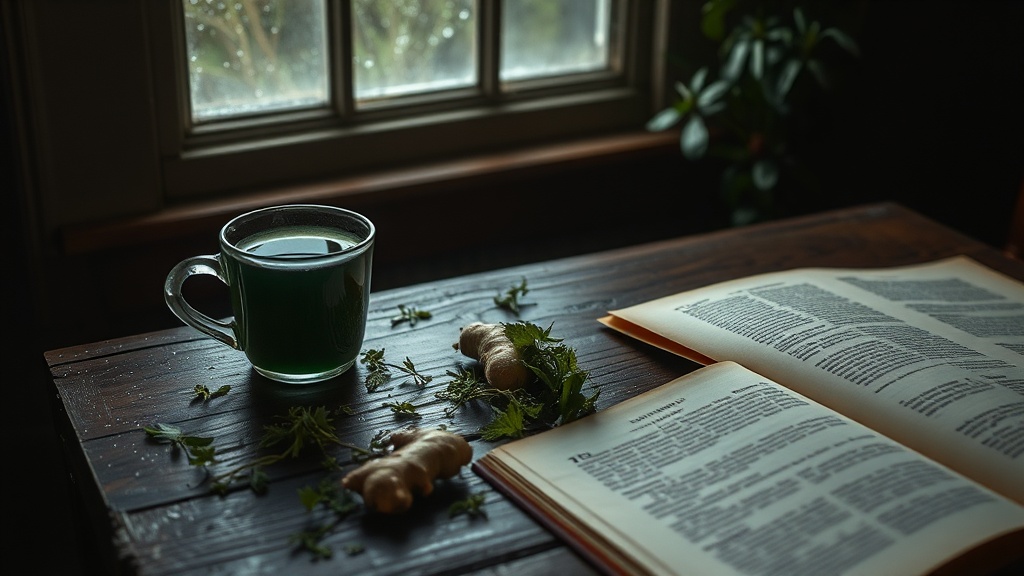
Spring Transition Herbs: What Actually Helps When Your Body Shifts Seasons

The equinox is two weeks away. You've probably noticed something: you're tired in a different way than you were in January. Maybe your digestion is doing something strange. Maybe you hit 3pm and feel oddly flat when the light through the window is, objectively, beautiful.
Here's what I want to say before anything else: that's real. It's not a character flaw. It's not a sign you need a liver flush. It's your body doing a reasonably sophisticated recalibration, and it's been doing it for a very long time.
Let me explain what's actually happening, and then we'll talk about what actually helps.
Why Your Body Notices Seasonal Shifts (It's Not Mysticism)
Here's the honest research-librarian version: your body is a light-tracking machine.
Serotonin synthesis is directly regulated by light exposure — specifically, light hitting your retina triggers a cascade that increases serotonin production. During winter months, you've been running on reduced light input, which typically means lower serotonin, slightly elevated melatonin production in the evenings, and a metabolism that, in many people, may shift — though the evidence on broad metabolic slowing in otherwise healthy adults is more mixed than you'd think from wellness content; the clearest data is in people with diagnosed SAD. This isn't metaphorical. SAD (Seasonal Affective Disorder) is a clinically recognized condition with real neurological correlates, not just "the winter blues."
When the light returns — and at mid-latitudes in the northern hemisphere, we're gaining roughly two minutes of daylight per day right now, faster if you're farther north — your circadian system has to recalibrate. This involves shifting the timing of cortisol peaks, adjusting melatonin onset, and reorienting your sleep-wake timing. This takes time. The equinox arrives on March 20th; your biology doesn't get the memo and comply instantly.
Meanwhile, digestive transit can slow in winter in some people — less physical activity, heavier foods, less hydration all contribute. Individual variation is real here; "winter definitely slows digestion" is more folk physiology than settled science. What's true is that plenty of people come out of winter with digestion that feels sluggish, for reasons that aren't always cleanly separable from lifestyle.
None of this requires a "detox." All of it responds well to some gentle, research-supported support.
The Detox Trap (I'm Just Going to Say It Directly)
Every March, my inbox fills with questions about liver cleanses. Every March, I take a breath and explain the same thing.
Your liver is not a bucket that fills with toxins and needs to be emptied. It's an organ running roughly 500 metabolic functions simultaneously, including most of the actual work of what people mean when they say "detox." It does not need dandelion bitters, lemon juice, or a 7-day cayenne situation. It needs you to stop smoking, moderate your alcohol, eat adequate protein, and get enough sleep.
The persistent popularity of spring detox programs is a marketing success story, not a physiological one. It exploits a real feeling (the sluggishness I described above) and offers a story that feels logical (winter accumulated toxins, spring = flush them out) while delivering something that's either harmless theater or, at worst, actively risky. Some "detox" protocols — particularly those featuring cascara sagrada or aggressive diuretic combinations — can cause electrolyte imbalances or interact badly with medications. High-dose milk thistle is generally well-tolerated, but I want to be precise: the robust evidence supports liver protection in people with existing liver disease, not liver "enhancement" in healthy people. It's not a performance upgrade for a functioning organ.
What you actually need is different, and more boring, and it works.
Herbs with Legitimate Research for Spring Transitions
I'm going to be honest about what the research shows and where the evidence is thinner. "Some studies" and "robust clinical trials" are not the same thing, and I'm not going to pretend otherwise.
Ginger (Zingiber officinale)
What the research shows: This is one of the better-studied herbs in digestive support. Multiple clinical trials — including work published in the Journal of Gastroenterology and elsewhere — have documented ginger's effects on gastric emptying time and GI motility. The active constituents, gingerols and shogaols, appear to work by interacting with 5-HT3 receptors in the gut and stimulating the production of digestive enzymes.
For spring, this matters because: if your digestion has been sluggish through winter, ginger is a legitimate and gentle way to wake it back up. It's not dramatic. But it's real.
How to actually use it: Fresh ginger tea (grate about a teaspoon of fresh root into hot water, steep 10 minutes) will give you more of the gingerols. Dried ginger has higher concentrations of shogaols, which affect the gut slightly differently. A tincture in vegetable glycerin is another option if you're avoiding alcohol. Timing: morning is reasonable, since you want digestive support earlier in the day.
Honest caveats: If you're on blood thinners (warfarin especially), talk to your prescriber before adding therapeutic doses. At culinary amounts it's generally fine.
Nettle (Urtica dioica)
What the research shows: Nettle leaf is genuinely mineral-dense — meaningful amounts of iron, calcium, magnesium, and potassium, plus chlorophyll. The mineral content has been measured analytically; bioavailability varies based on preparation, but infusions do extract meaningful amounts.
There are also small studies on nettle for allergy symptom reduction, which is seasonally relevant given March pollen counts. I want to be careful here: the allergy evidence is modest and inconsistent across trials. Some studies show reduction in rhinitis symptoms; others show minimal effect. The mineral content is the stronger, better-supported reason to reach for nettle in spring.
The "spring tonic" framing that traditional herbalism uses for nettle is actually one of the cases where the traditional reasoning — "use what's abundant in early spring to replenish after a mineral-lean winter" — lines up reasonably with what we know.
How to actually use it: The key word here is infusion, not tea. A quick 3-minute steep barely extracts nettle's minerals. A real nettle infusion uses one ounce of dried nettle leaf in a quart of boiling water, steeped covered for 4–8 hours (or overnight). The result is dark green, a little grassy, and nutritionally quite different from a quick bag-in-mug situation. I drink mine cold, with a squeeze of lemon.
Honest caveats: If you have kidney disease, talk to your doctor — the mineral load matters. For most people, it's a food-grade plant and extremely safe.
Lemon Balm (Melissa officinalis)
What the research shows: This is where I have to be more careful. Lemon balm has a smaller research base than I'd like. There are studies — some randomized, placebo-controlled — showing modest improvements in mood, mild anxiety reduction, and cognitive performance in the short term. The effect sizes are not dramatic. The proposed mechanism involves rosmarinic acid inhibiting GABA transaminase, which would increase GABA availability — plausible, and in the right direction.
What I can honestly say: lemon balm is a mild and pleasant support for nervous system settling. If you're in that flat, low-grade-gray mood that early spring can bring before the serotonin catches up with the light, lemon balm is a reasonable thing to reach for. It's not an antidepressant, and I'd be doing you a disservice to call it one.
How to actually use it: Fresh lemon balm, if you can grow it or access it, is noticeably more aromatic and I think more effective than dried. A handful of fresh leaves in hot water for 10 minutes, covered. With dried, use generously — it's mild enough that a slightly stronger brew isn't a problem. Afternoon or evening works well.
Honest caveats: Some evidence of interaction with thyroid medications. If you're on thyroid hormone replacement, worth flagging with your prescriber.
Tulsi / Holy Basil (Ocimum tenuiflorum)
What the research shows: Tulsi is an adaptogen, and I use that word carefully because it's been marketing-captured. What it means in the pharmacological sense is an herb that appears to support the body's response to stressors without stimulating or sedating in a one-directional way. For tulsi, there's research — modest but present — on cortisol modulation and circadian support. Several small human trials have documented reductions in stress markers and improvements in sleep quality; methodological quality varies across these studies, and I'd describe the overall evidence base as promising but preliminary. More recent work has looked at its effects on the HPA (hypothalamic-pituitary-adrenal) axis, with findings that point in the right direction but need replication at scale.
The circadian piece is what makes tulsi particularly interesting for spring transition. Your cortisol rhythm is part of what's recalibrating when the light shifts. Tulsi's effects on the HPA axis may genuinely help that recalibration happen more smoothly — but "may" is doing real work in that sentence. I'm not going to oversell a preliminary signal.
How to actually use it: Tulsi tea is wonderful — genuinely aromatic, slightly clove-y, and one of the herbs that actually tastes like what it's supposed to do for you. Tincture is also effective. Timing: morning works well because you want cortisol support in the part of the day when cortisol is naturally higher.
Honest caveats: Blood sugar effects documented in diabetic subjects — if you're managing blood sugar with medication, watch it. Avoid in pregnancy (historically considered an emmenagogue in high doses, though culinary amounts are fine).
What You Should Actually Expect
I want to be very clear about timelines, because this is where herbal wellness marketing does the most damage.
You are not going to take a nettle infusion on Saturday and feel like a new person on Sunday. That's not how any of this works, and anyone who tells you otherwise is selling you something.
Digestion: If your digestion has been sluggish through winter, normalization is a multi-week process that depends on your full picture — movement, hydration, diet, sleep. Ginger supports a natural process; it doesn't override it, and I'd be making up a specific number if I gave you a precise timeline. Consistent use over several weeks, alongside the lifestyle factors that actually move the needle, is the honest framing.
Energy and mood: The primary driver of your mood and energy improvement in spring is light. Full stop. The circadian reset happens because you're getting more light in the mornings, your serotonin production picks up, your melatonin timing shifts. Lemon balm and tulsi can support that process — they don't replace it. Get outside in the morning. Even 10 minutes in early daylight, even on a cloudy day, matters more than any herb I can recommend.
Gradual is correct: The sluggishness of early spring, the weird couple of weeks where you're neither in winter-mode nor spring-mode, is a real transition. Herbs work best when you treat them as support for a process that's already happening, not a switch to flip.
Putting It Together: A Simple Spring Protocol
Here's what I'd actually suggest for the next three weeks:
Morning: Tulsi tea while you're getting daylight — bonus points if you can drink it outside, or by a window. 10 minutes of actual morning light, not through screens.
With or after breakfast: Fresh ginger infusion if your digestion has been slow. If it's fine, skip it — don't fix what isn't broken.
Afternoon: Lemon balm if you're hitting the flat patch. A real infusion with decent quality dried herb, not a tea bag.
2–4 times per week: Overnight nettle infusion. This is a commitment — you have to remember to set it up the night before — but if you do it regularly for a few weeks, the difference is noticeable.
What I'm not including: A liver cleanse, a juice fast, a 10-day detox kit, or anything that costs more than the herb itself.
The equinox is coming. Your body is already responding to the light shift whether or not you do anything — the herbs above just make that process a little smoother, a little more supported. That's what herbs can legitimately do. Not more, but not nothing.
Curious about any of these herbs in more detail? Drop a question in the comments — I read them all, and I'll answer specifically.
— Sloane